Showing posts with label INNOVATION. Show all posts

Saturday, 30 November 2013

Move Over Facebook: Where Millennials Are Flocking to Next And How to Reach Them.

Move Over Facebook: Where Millennials Are Flocking to Next And How to Reach ThemAs someone interested in trends among the millennial generation, there was one particular statistic that caught my eye and continues to pop up on the radar: Only six percent of 12- to 17-year-olds who use the web want to be friends with a brand on Facebook, according to a Forrester 2011 report.
Circumstantially, this was supported by a millennial conference I attended when a panel of college students all raised their hands when asked if they were thinking about logging out of Facebook for good. While it wasn't a scientific study, the observation spoke volumes as to where Facebook may be heading.
And now, fairly recent research backs it up. With more than half of teens stating social media plays a role in purchases, Twitter has surpassed Facebook as the site deemed most important, according to a fall survey by investment-banking firm Piper Jaffray. The report also found Facebook's popularity is diminishing among this key demographic, with 23 percent of teenagers stating it is the most important social network site, down from 33 percent six months ago and 42 percent a year ago.
In the past Facebook has denied this trend is occurring, but in its third-quarter earnings call this month, the company finally acknowledged the fact the social network site is waning among youths.
"Our best analysis on youth engagement in the U.S. reveals that usage of Facebook among US teens overall was stable from Q2 to Q3, but we did see a decrease in daily users, specifically among younger teens," CFO David Ebersman said.
What's going on here? In addition to the obvious problem of having to accept friend requests from grandma and long lost relatives, privacy is a big concern. Facebook just cut a privacy setting that kept all user names out of the social network’s graph search. It also specifically targeted the teen demographic when it decided to allow 13- to 17-year-olds the ability to share photo, updates and comments with the public, not just friends. The result? Advertisers now have access to private user information they didn't have before, a move that may not bode well with teens.
So how should marketers respond to this rapidly changing social environment? Here are three tips for approaching millennials -- no matter what social platform they flock to in the coming years:
Listen rather than speak. "[Brands] might be better off being more reactive than proactive, and they should listen," according to the same Forrester report referenced earlier.
Indeed, the advantage that the proliferation of social platforms and social media monitoring tools now offer brands is an opportunity to easily keep their pulse on what consumers think and, possibly even more important, if there is anything going wrong. If you sell something, chances already are that someone, somewhere, is already talking about your product.
Act on those insights. By focusing on listening to those conversations already taking place, brands can provide better customer service, respond to problems before they escalate and easily identify areas for innovation. The simple act of tweeting information back or addressing customer service issues upon learning of problems can lead to big public relation wins for brands. Why? Millennials aren't necessarily expecting a brand to personally reach out to them to fix problems. In fact, it's even considered "cool" among millennial consumers when a brand takes the time to personally reach out.
Beyond being a nice gesture, why does this matter? We're talking bottom line impact if done right. According to a 2012 survey by American Express, social media users are willing to reward companies for top-notch service, spending 21 percent more with those that provide it. And thanks to the millennial consumers' larger presence on social networks companies that provide excellent customer service reap huge rewards when a happy millennial consumer shares one of these memorable moments with his or her friends and associates via Facebook or Twitter.
Seek out and engage your biggest brand advocates. If you're taking time to listen to what's being said out there about your brand, you'll not only be able to identify potential problems and opportunities to provide better customer service, but you'll also know who your biggest brand advocates are.
The benefit? These individuals are the ones who are already more likely to want to engage and help support your brand. It gets to that 80/20 rule: Twenty percent of the consumer base is typically responsible for 80 percent of the profits. Utilize the access those social media platforms provide by reaching out and engaging them. It could range from customer surveys you may be conducting to getting their feedback on marketing campaigns or even getting their input on new product development. As research has uncovered, millennials enjoy collaborating and knowing that they've made an impact on things, especially if it involves your next, new product offering.
Combining these tips together, brands will be poised to win no matter what social platform millennials choose to flock to next.

Sunday, 24 November 2013

A Fashionable, Inflatable Bike Helmet Collar? Yes, You Read That Right.

A Fashionable, Inflatable Bike Helmet Collar? Yes, You Read That Right.It seems like every other day we read about some far-out, new technology that makes us scratch our heads and say, "What the heck?" In this series, we'll take a look at all types of crazy new gadgets, apps and other technologies -- and the entrepreneurs dreaming them up.
One startup is using technology to reinvent a piece of cumbersome safety equipment -- with a fashionable flair.
Everyone knows that wearing a helmet is important while you're riding a bicycle. After all, that precious brain inside your noggin is pretty essential. But bike helmets, while much more fashionable than they used to be, are still fairly cumbersome and awkward, especially if you spend a lot of time making sure your coif is perfectly coiffed and would like it to remain so.
In 2005, Anna Haupt and Terese Alstin, then industrial design students at the University of Lund in Sweden, decided to tackle that issue in their master's thesis. It was a response to a new law mandating helmet use for cyclists under age 15, and the subsequent debates over whether a similar mandate for adults should be implemented. The problem, the women proposed, was to create a helmet that adults would be happy to wear, whether they were required to do so or not.
Their idea was to create an airbag "helmet" that is actually a collar worn around the neck, which inflates instantly during a crash. The device is called the Hövding.
The team contacted a head trauma specialist, studied countless hours of bicycle crash data and staged their own controlled crashes to collect movement patterns. Test cyclists also gathered data about normal riding conditions -- the sorts of starts, stops and events that happen during everyday cycling. They then used this data to develop an algorithm that can distinguish normal cycling from accidents. After all, it wouldn't be helpful if your airbag helmet deployed when you bend down to pick up your keys, right?
Made of an ultra-strong, rip-proof nylon fabric, the airbag looks like a hood when inflated, giving the wearer greater coverage than a traditional helmet, as well as softer, gentler shock absorption. Unlike an automobile airbag, which deflates again almost as soon as it deploys, the Hövding is designed to remain inflated for several seconds, allowing it to withstand several impacts during the same accident.
Sounds kinda wacky, right? Check out this video:

So is it safe? The short answer is yes. According to the company's website, "Hövding is CE marked and has successfully undergone SP Technical Research Institute of Sweden's extensive approval process. CE marking is required for a cycle helmet to be able to be sold in Europe, certifying that the helmet complies with the requirements laid down in the EU's Personal Protective Equipment Directive." That means it meets or exceeds every standard for safety related to bicycle helmets sold in Europe.
Like a regular bicycle helmet, the Hövding can't be reused after it's deployed during an accident. But unlike a regular helmet, it might actually be able to help with future product safety developments. Inside the collar there is a black box that records 10 seconds of data on the cyclist's movement patterns from an accident. In the event of an accident, the company requests that you send the Hövding back to them so that they can use this data in further research.
Such a stylish and innovative device isn't inexpensive. One collar plus a colorful shell will set you back about $535, but some insurance companies will subsidize the cost of protective gear such as the Hövding.
Here's to safe, fashionable cycling.

This Tiny Gadget Can Turn Virtually Anything Into a Musical Instrument

This Tiny Gadget Can Turn Virtually Anything Into a Musical InstrumentIt seems like every other day we read about some far-out, new technology that makes us scratch our heads and say, "What the heck?" In this series, we'll take a look at all types of crazy new gadgets, apps and other technologies -- and the entrepreneurs dreaming them up.
Music and technology have been comfortable bedfellows since before someone strummed the first electric guitar. But creating your own instruments -- electronic or otherwise -- can be a difficult proposition, and not one easily undertaken by someone without training.
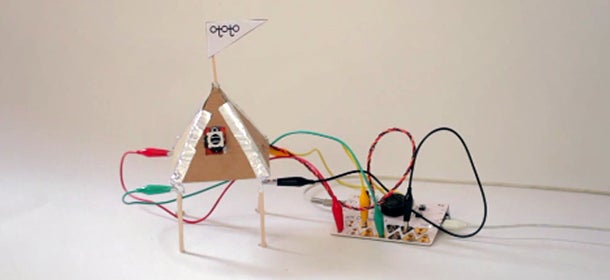
That is exactly the problem British creative agency Dentaku decided to tackle when it created the Ototo, a pocket-sized circuit board designed to be a "musical invention kit." Translation: this thing can turn virtually any object into a musical instrument.
Simple enough that anyone can use it, the Ototo lets even the most musically or mechanically inept create a musical instrument out of just about anything -- no coding or soldering involved. It consists of a small control board about the size of a cassette tape that has a speaker and 12 triangular touch inputs which come pre-programmed so you can use them like piano keys.
Even more fun can be had when you use the included set of wires with alligator clips on the ends to connect the Ototo to any object that's even slightly conductive, letting you turn pots and pans, aluminum foil, a chocolate bar or even a plant into a musical instrument. Other accessories act like wah-wah pedals, letting you add even more variety to the sounds you can make.
The platform is also fully-hackable and compatible with the Arduino open-source electronic prototyping platform, so if you're more mechanically or electronically inclined, the possibilities are nearly endless. The sounds created by the Ototo are reminiscent of old-school Moog synthesizers, with a fun, futuristic feeling that's only heightened when you realize you can even turn a pencil drawing into something that plays music.


When it was time for the designers at Dentaku to seek funding for the Ototo, they decided to skip the now-ubiquitous Kickstarter crowd-sourcing method in favor of applying for traditional arts grants. A British arts program called Near Now found their idea intriguing enough to work with, and offered to fund it. Near Now focuses on arts and technology in everyday life, and Ototo is an example of interactive art that promotes design and digital literacy. Near Now Director Mat Trivett explains in Wired that they are "excited at the potential of Ototo as both an accessible tool to learn the basics of physical computing and interaction design and as an advanced

How One Startup Plans to Replace Every Card in Your Wallet


Saturday, 23 November 2013

3 Things You Need to Know About Launching a Product Business

3 Things You Need to Know About Launching a Product BusinessIt is a golden-age for innovation with companies revamping the business of invention and democratizing the way we monetize new ideas. Think Kickstarter, Quirky and -- shameless plug of my own business -- Trident Design.
If you have an idea for a brilliant invention (you know you have at least one!) and are thinking about pursuing it, your options -- apart from suing people based on patents -- can be grouped into three categories: make and sell it yourself, license it or submit it to a crowdsourcing site.
How do you know which one of these paths is the right one for you and your idea? That can be a confusing question, and there is no “right” answer. Let's take a look at the first option: starting a company to make and sell your invention.
Making and selling a product yourself means setting up production, business systems and a sales team. It is exciting, challenging and a lot of work. It can’t really be done casually given that a normal manufacturing company can have many employees.
I have seen many lives made stressful by people underestimating the challenges of starting a product company. You should only pursue this path if you are so passionate about your product that you want to sleep with it under your pillow. It should be your undying dream to stand at the prow of a yacht with the name of your product on its side.
1. You can make (or lose) a whole bunch of money. The pro side of the equation is that starting a company can add up to bigger numbers for you and your business. If you build a successful product, you can sell a business rather than license intellectual property, which can have a much higher value.
Starting a business has the biggest potential payoff out of all the ways of commercializing your idea but you will need the wherewithal, ability to build a team and passion for your product. Be honest about your level of commitment to a product before you risk too much.
Despite what you might think from seeing “easy” Kickstarter successes, starting a business requires tremendous effort and investment. Once you have half of your life savings invested will you be able to walk away? Only go down this path if you can’t help but do it because you can’t not do it. If you can conceive of a world where you license the product, that is probably your best option -- at least at first.
2. It takes twice as long as you think to get to market. I have launched more than 70 products myself. Products take about twice as long and cost twice as much as people think they will, no matter how well you think you’ve planned. This means you need to be extra conservative when assessing what you can afford to risk in a product venture. I have seen many promising products fail because the inventor had to return to other employment in order to pay the bills.
3. You can't stop at just one product. Another thing to be aware of is that you will need to immediately start developing follow-up products in order for your company to survive. Very few companies survive on just one or two products. You have to keep adding new items every year in order to stay relevant and ahead of the innovation curve. If you don’t have ideas, you need to be considering where you are going to source them. They will cost money to develop and may need to be brought to market before the first product is fully developed in the marketplace.
I do not intend to sound discouraging. Making and selling your own products is a rush and we are getting ready to launch a couple of Kickstarter campaigns here at Trident for products we feel passionate about ourselves.
But go in with their eyes open, ready to smash all the obstacles that will present themselves and stick it out through the long slog to victory. I've met many inventors who unwittingly got in way over their heads and could have pursued a much lower risk path to commercialization, like licensing or submitting.
Take a look at your idea. Ask yourself the following questions and answer honestly:
  • How much do I love this product and want to live and breathe it every day?
  • Do I want to keep my day job?
  • Am I in love with the industry of my idea, or do I just want to make money?
  • How much do I love sleep?
  • How much money can I access? How much will I need?
  • What lifestyle do I want?
  • According to experts, how big is the opportunity is this idea?
If you are honest with yourself and still want to start a company, go for it! If I raise doubts in your mind, please, seriously consider other options.

13 Hilarious Inventions We Can’t Believe Exist, and Are Real Businesses

13 Hilarious Inventions We Can’t Believe Exist, and Are Real BusinessesSome inventions address needs that everyone has and go on to change the world.
The Internet serves our constant craving for information; the internal combustion engine let anyone efficiently do mechanical work with little physical effort; antibiotics significantly reduced mortality rates around the world.
Then there are the inventions that are the result of someone asking, "Hmm, I wonder if that would be a good idea?"
From a "onesie" that lets your baby mop your floors to a mic-shaped sponge for rocking out in the shower, these are the inventions that are more noteworthy for the fact that anyone thought of them in the first place than for what they actually accomplish.

Thursday, 21 November 2013

Branding Firm Wows With Fresh Package Designs

Branding Firm Wows With Fresh Package DesignsWho: Dallas-based packaged-goods company Kusin & Kusin launched the first-ever dry-application, odor-eliminating pet wipe, in a clever reusable pouch designed by Los Angeles branding firm Ferroconcrete.

What: Reviver Pets Freshening Swipes are sold exclusively at Petco. The existing "pet-odor removing" products are based on wet sprays or wet wipes, says Scott Meisse, project director at Ferroconcrete. "Reviver Pets is radically different by being dry and completely reusable, two things no one would expect in the category. We didn't really consider any product as competition; we considered consumers' expectations and purchase habits as the competition and greatest challenge."

Reviver Pets Freshening Swipes

Why we love it: This package has personality: It is fun yet clean, bold and effective. The resealable perforated pouch, with minimal marketing copy, is designed to sit in a custom countertop display. It relies on a clear window to show the dry wipe, and the shape of the window clearly indicates the end user: dogs, cats or pet parents.