Showing posts with label Forrester. Show all posts

Saturday, 30 November 2013

Is Facebook Really a Failure to Marketers?

Is Facebook Really a Failure to Marketers?
What seems to be an unfair review of Facebook's marketing platform by respected research firm Forrester has been making the media rounds.
In an open letter to Facebook's CEO Mark Zuckerberg, Forrester's vice president and principal analyst Nate Elliot takes aim at the social network's value for marketers.
With the opening sentence, "Facebook is failing marketers," Elliot delves into why Facebook has been a less than stellar social platform for these folks.
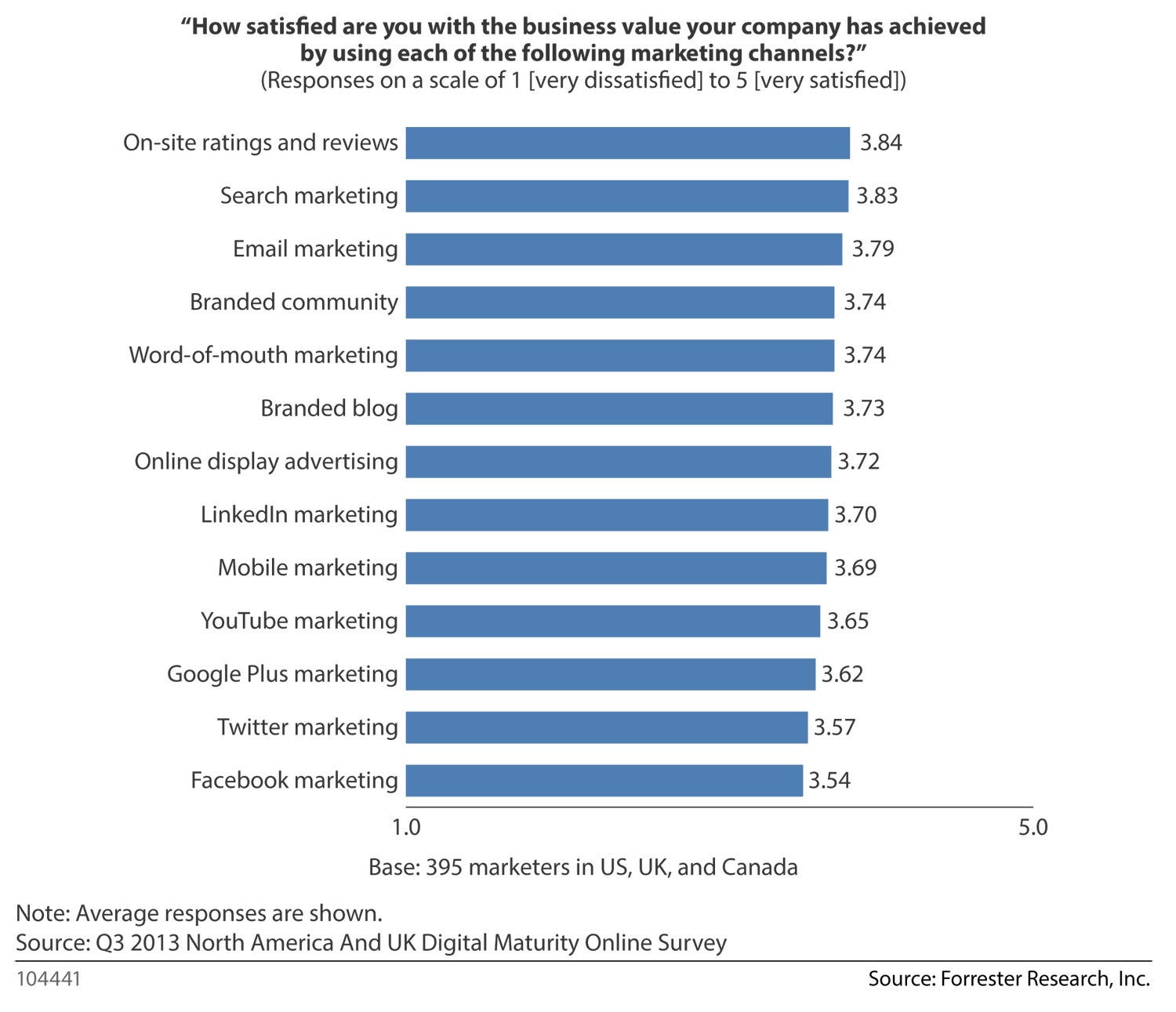
Citing a Forrester survey of 395 marketers and executives at large companies located in the U.S., Canada and the U.K, Forrester was told by the sample that "Facebook creates less business value than any other digital marketing opportunity." Yikes. In fact, according to Forrester, out of 13 different online marketing strategies and sites, Facebook came in dead last, with a satisfaction score of 3.54 on a 5-point scale.

Is Facebook Really a Failure to Marketers?
The reasoning for the apparent disappointment is two-fold. For one, Forrester points out that Facebook isn't good at driving engagement between businesses and their customers.
"Your sales materials tease marketers with the promise that you’ll help them create such connections. But in reality, you rarely do," the report states. Backing up that remark, Forrester claims Facebook, on average, only displays a brand's posts in 16 percent of its fans' newsfeeds. 
Secondly, the site is focusing on traditional, web 1.0 display ads, with less than 15 percent of its ads utilizing social data to reach a more targeted audience.
Sound points, but when you get down to the methodology, I am not how much stock I'd put in Facebook being a disappointment to marketers. 
Keep in mind Forrester only surveyed 395 companies, which might not serve as a big enough pool to provide such a blanket statement that Facebook is failing marketers. Also, Forrester didn't disclose the companies they surveyed, stated the sample was not random and the respondents were rewarded for their information. Plus, Facebook's satisfaction score of 3.54 is 0.3 points away from first place, which could have more to do with a statistical error and less to do with dissatisfaction. 
For its part, Facebook told Business Insider, "the conclusions in this report are at times illogical and at others irresponsible." 
The findings also don't seem to be deterring businesses from jumping on the Facebook bandwagon. According to the report, Facebook brought in $4 billion in advertising revenue last year and 79 percent of businesses market on Facebook.
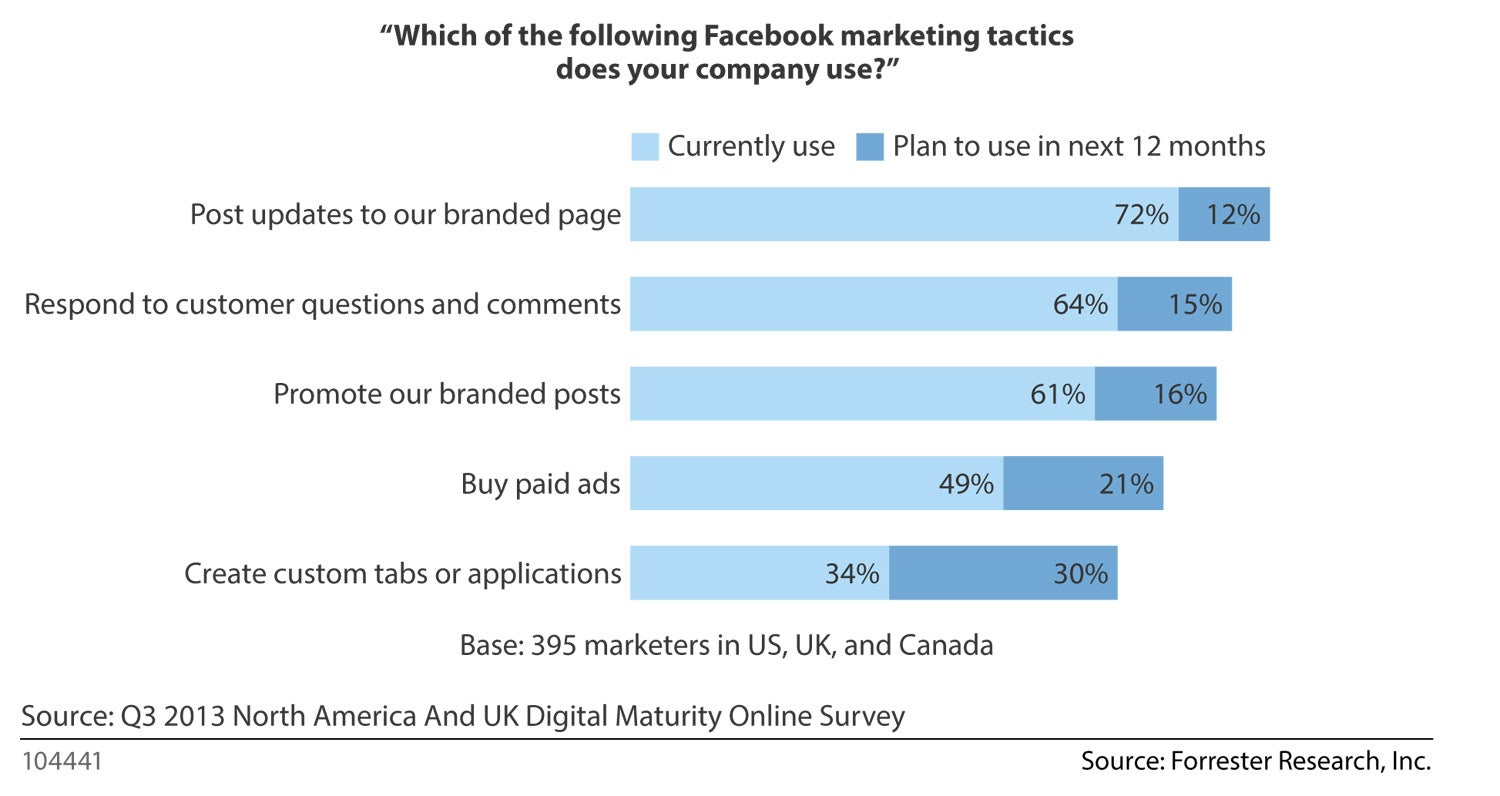
Also, many of those 395 companies surveyed for the report do, or plan on using various Facebook marketing strategies.
Is Facebook Really a Failure to Marketers?
To add to that, Adobe released its first annual Social Media Intelligence report and ad clicks, impressions and marketer's return on investment all increased from 2012 to 2013. The social network's ads were clicked on 29 percent more in 2013, return on investment jumped by 58 percent from last year and click-through-rate was up a whopping 275 percent. 
Also, Google, a company some may state is an arch enemy of Facebook, deciding to partner with the social network and sell its ads on Google DoubleClick Bid Manager. 
But Forrester cautions that Facebook better get its act together or the future may not be so rosy. 
"We don’t believe that Facebook will make the changes needed to win back marketers’ hearts. In fact, we don’t believe the company even sees the need to change: Its enormous revenues have blinded it to marketers’ growing dissatisfaction. But if it doesn’t change, the results will be dire."

Move Over Facebook: Where Millennials Are Flocking to Next And How to Reach Them.

Move Over Facebook: Where Millennials Are Flocking to Next And How to Reach ThemAs someone interested in trends among the millennial generation, there was one particular statistic that caught my eye and continues to pop up on the radar: Only six percent of 12- to 17-year-olds who use the web want to be friends with a brand on Facebook, according to a Forrester 2011 report.
Circumstantially, this was supported by a millennial conference I attended when a panel of college students all raised their hands when asked if they were thinking about logging out of Facebook for good. While it wasn't a scientific study, the observation spoke volumes as to where Facebook may be heading.
And now, fairly recent research backs it up. With more than half of teens stating social media plays a role in purchases, Twitter has surpassed Facebook as the site deemed most important, according to a fall survey by investment-banking firm Piper Jaffray. The report also found Facebook's popularity is diminishing among this key demographic, with 23 percent of teenagers stating it is the most important social network site, down from 33 percent six months ago and 42 percent a year ago.
In the past Facebook has denied this trend is occurring, but in its third-quarter earnings call this month, the company finally acknowledged the fact the social network site is waning among youths.
"Our best analysis on youth engagement in the U.S. reveals that usage of Facebook among US teens overall was stable from Q2 to Q3, but we did see a decrease in daily users, specifically among younger teens," CFO David Ebersman said.
What's going on here? In addition to the obvious problem of having to accept friend requests from grandma and long lost relatives, privacy is a big concern. Facebook just cut a privacy setting that kept all user names out of the social network’s graph search. It also specifically targeted the teen demographic when it decided to allow 13- to 17-year-olds the ability to share photo, updates and comments with the public, not just friends. The result? Advertisers now have access to private user information they didn't have before, a move that may not bode well with teens.
So how should marketers respond to this rapidly changing social environment? Here are three tips for approaching millennials -- no matter what social platform they flock to in the coming years:
Listen rather than speak. "[Brands] might be better off being more reactive than proactive, and they should listen," according to the same Forrester report referenced earlier.
Indeed, the advantage that the proliferation of social platforms and social media monitoring tools now offer brands is an opportunity to easily keep their pulse on what consumers think and, possibly even more important, if there is anything going wrong. If you sell something, chances already are that someone, somewhere, is already talking about your product.
Act on those insights. By focusing on listening to those conversations already taking place, brands can provide better customer service, respond to problems before they escalate and easily identify areas for innovation. The simple act of tweeting information back or addressing customer service issues upon learning of problems can lead to big public relation wins for brands. Why? Millennials aren't necessarily expecting a brand to personally reach out to them to fix problems. In fact, it's even considered "cool" among millennial consumers when a brand takes the time to personally reach out.
Beyond being a nice gesture, why does this matter? We're talking bottom line impact if done right. According to a 2012 survey by American Express, social media users are willing to reward companies for top-notch service, spending 21 percent more with those that provide it. And thanks to the millennial consumers' larger presence on social networks companies that provide excellent customer service reap huge rewards when a happy millennial consumer shares one of these memorable moments with his or her friends and associates via Facebook or Twitter.
Seek out and engage your biggest brand advocates. If you're taking time to listen to what's being said out there about your brand, you'll not only be able to identify potential problems and opportunities to provide better customer service, but you'll also know who your biggest brand advocates are.
The benefit? These individuals are the ones who are already more likely to want to engage and help support your brand. It gets to that 80/20 rule: Twenty percent of the consumer base is typically responsible for 80 percent of the profits. Utilize the access those social media platforms provide by reaching out and engaging them. It could range from customer surveys you may be conducting to getting their feedback on marketing campaigns or even getting their input on new product development. As research has uncovered, millennials enjoy collaborating and knowing that they've made an impact on things, especially if it involves your next, new product offering.
Combining these tips together, brands will be poised to win no matter what social platform millennials choose to flock to next.