Showing posts with label FACEBOOK. Show all posts

Saturday, 30 November 2013

With Facebook's Media Referral Traffic Up 170%, Site Announces 'Stories to Share'

With Facebook's Media Referral Traffic Up 170%, Site Announces 'Stories to Share'Facebook's partnerships with media organizations seem to be paying off.
Today, the social network reported the average referral traffic from Facebook to media sites has increased more than 170 percent this year. 
The company went into more detail claiming TIME saw traffic grow by 208 percent, referrals to listicle-loving BuzzFeed rose 855 percent and sports site Bleacher Report is up a whopping 1081 percent.
Facebook also noted the more media sites post, the more traffic will be driven to a site, claiming referrals jumped 80 percent when posting frequency increased. 
But that doesn't mean businesses should go on a posting frenzy by providing updates every other minute, as this will be looked upon as spammy to your readers. Facebook states, "there’s no magic number of how many more posts will impact referral traffic for all Facebook pages. Page administrators should test how increased posting impacts their referrals, Likes and overall engagement."
With these released findings, Facebook has decided to up its game with the media. The company is testing a feature called Stories to Share. The tool will allow the social network to suggest which articles organizations should post to their Facebook page. So, if there is a story on Entrepreneur that is hot but hasn't yet been posted on Facebook, the company will recommend we put it on our page. 
All this focus on getting the media on board, has helped Facebook nab the No. 1 spot for referral traffic from social networks, according to digital tool company Shareaholic. According to the findings, Facebook accounted for more than 10 percent of traffic to media publications, up 58.8 percent from the same time last year.
While Facebook nabbing the No. 1 spot may not come as too much of a shock, it is interesting which social network came in second place: Pinterest. The wedding-loving, food-obsessed pin site managed to beat out Twitter, LinkedIn and Reddit. In fact, with more than 3 percent of media referrals coming from Pinterest, it drives more traffic than those three sites combined. 
Shareaholic's Social Media Traffic Report was based on 13 months of data collected from 200,000 publishers.

How You Can Win at Social Media Right Now (Hint: Silly Cat Pics Don't Cut It)

How You Can Win at Social Media Right Now (Hint: Silly Cat Pics Don't Cut It)Today, it takes more than a couple of cat pictures for a brand to be successful on social media. Whether on Pinterest or Vine, brands constantly need to update their tactics and strategies in online marketing to stay relevant and engage users.
The Webby Awards released a list of 24 brands that are doing it right on digital media. These organizations are gaining followers and raising awareness of their brand, while also providing some key lessons in how to market with social media.
One of the key qualities among the companies on the list is an ability to tap into a community and supercharge it. Greatist, a website that inspires readers to make healthy choices every day, utilizes Instagram and Twitter to connect users to the website and each other. Followers add #imagreatist (I’m a Greatist) to photos of healthy food, Tweets discussing their exercise regime and workout selfies. Tagging the photo spreads brand awareness, creates content for the community and fosters engagement.
Brands on the list also found success in trying out new forms of social media to engage users. General Electric recently used Vine to encourage people to “pack as much science as you can” into a six-second video. Using the hashtag #6SecondScience, GE promoted its core values, raised brand awareness and helped their audience learn to use Vine.
One of the biggest takeaways of the report was that organizations can’t risk sounding too robotic or “corporate” online. If an actual machine, The Mars Curiosity rover, can create Tweets that are full of personality, other brands should be able to follow suit. “Curiosity is the biggest, most complex spacecraft ever sent to the surface of another planet,” says Veronica McGregor, a NASA News and Social Media Manager, in the report. “Her enthusiasm and personality draw from the people on the mission, and she has a rock-zapping laser! So the voice has to be both confident and fun.” With 20 percent of adult Internet users active on Twitter, engaging Tweets are becoming increasingly important.
Check out the full report for how companies like Red Bull, Kayak, Shake Shack, and more use everything from Facebook to Snapchat to build their brand on social media.

Is Facebook Really a Failure to Marketers?

Is Facebook Really a Failure to Marketers?
What seems to be an unfair review of Facebook's marketing platform by respected research firm Forrester has been making the media rounds.
In an open letter to Facebook's CEO Mark Zuckerberg, Forrester's vice president and principal analyst Nate Elliot takes aim at the social network's value for marketers.
With the opening sentence, "Facebook is failing marketers," Elliot delves into why Facebook has been a less than stellar social platform for these folks.
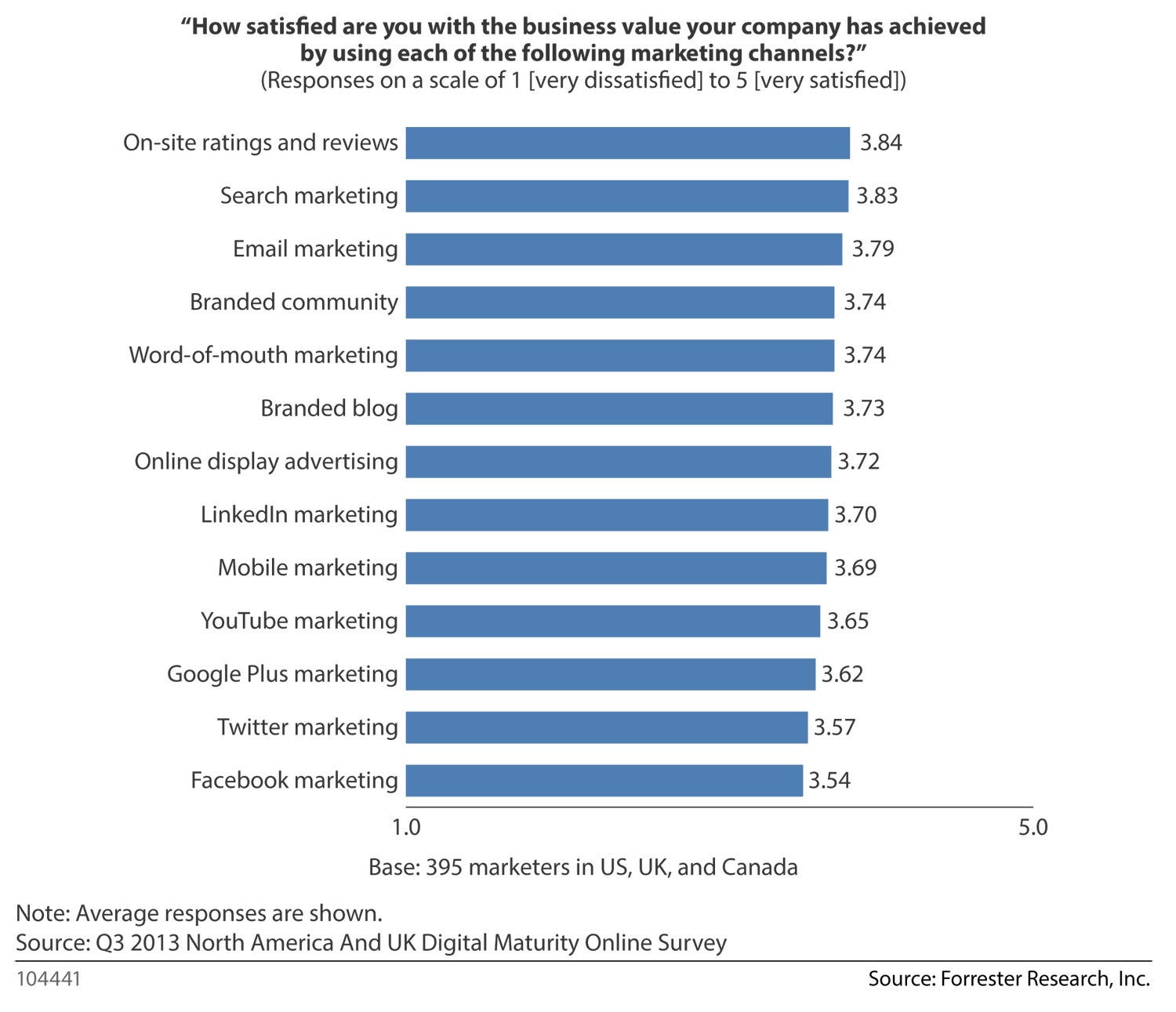
Citing a Forrester survey of 395 marketers and executives at large companies located in the U.S., Canada and the U.K, Forrester was told by the sample that "Facebook creates less business value than any other digital marketing opportunity." Yikes. In fact, according to Forrester, out of 13 different online marketing strategies and sites, Facebook came in dead last, with a satisfaction score of 3.54 on a 5-point scale.


Is Facebook Really a Failure to Marketers?
The reasoning for the apparent disappointment is two-fold. For one, Forrester points out that Facebook isn't good at driving engagement between businesses and their customers.
"Your sales materials tease marketers with the promise that you’ll help them create such connections. But in reality, you rarely do," the report states. Backing up that remark, Forrester claims Facebook, on average, only displays a brand's posts in 16 percent of its fans' newsfeeds. 
Secondly, the site is focusing on traditional, web 1.0 display ads, with less than 15 percent of its ads utilizing social data to reach a more targeted audience.
Sound points, but when you get down to the methodology, I am not how much stock I'd put in Facebook being a disappointment to marketers. 
Keep in mind Forrester only surveyed 395 companies, which might not serve as a big enough pool to provide such a blanket statement that Facebook is failing marketers. Also, Forrester didn't disclose the companies they surveyed, stated the sample was not random and the respondents were rewarded for their information. Plus, Facebook's satisfaction score of 3.54 is 0.3 points away from first place, which could have more to do with a statistical error and less to do with dissatisfaction. 
For its part, Facebook told Business Insider, "the conclusions in this report are at times illogical and at others irresponsible." 
The findings also don't seem to be deterring businesses from jumping on the Facebook bandwagon. According to the report, Facebook brought in $4 billion in advertising revenue last year and 79 percent of businesses market on Facebook.
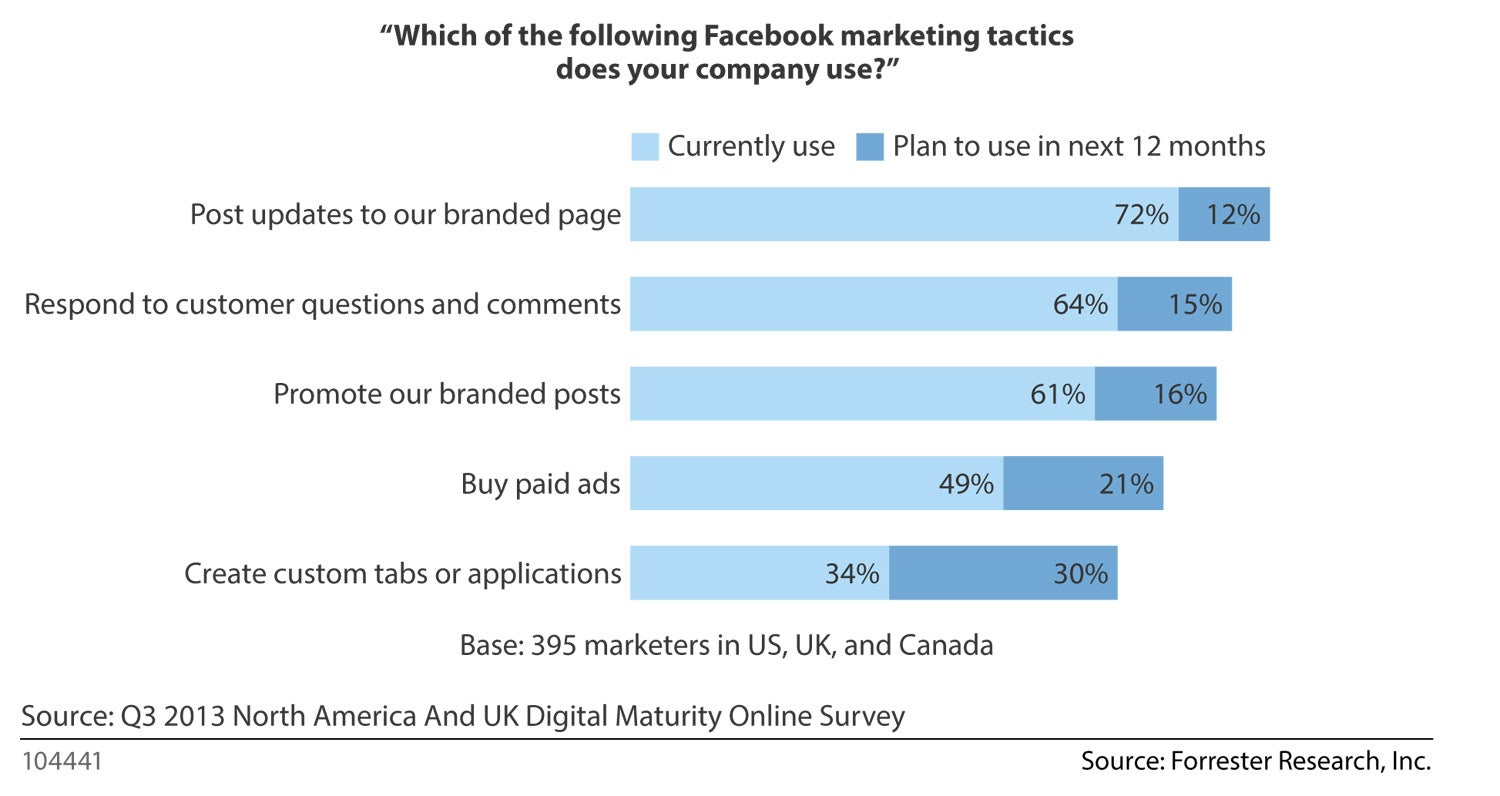
Also, many of those 395 companies surveyed for the report do, or plan on using various Facebook marketing strategies.
Is Facebook Really a Failure to Marketers?
To add to that, Adobe released its first annual Social Media Intelligence report and ad clicks, impressions and marketer's return on investment all increased from 2012 to 2013. The social network's ads were clicked on 29 percent more in 2013, return on investment jumped by 58 percent from last year and click-through-rate was up a whopping 275 percent. 
Also, Google, a company some may state is an arch enemy of Facebook, deciding to partner with the social network and sell its ads on Google DoubleClick Bid Manager. 
But Forrester cautions that Facebook better get its act together or the future may not be so rosy. 
"We don’t believe that Facebook will make the changes needed to win back marketers’ hearts. In fact, we don’t believe the company even sees the need to change: Its enormous revenues have blinded it to marketers’ growing dissatisfaction. But if it doesn’t change, the results will be dire."

Move Over Facebook: Where Millennials Are Flocking to Next And How to Reach Them.

Move Over Facebook: Where Millennials Are Flocking to Next And How to Reach ThemAs someone interested in trends among the millennial generation, there was one particular statistic that caught my eye and continues to pop up on the radar: Only six percent of 12- to 17-year-olds who use the web want to be friends with a brand on Facebook, according to a Forrester 2011 report.
Circumstantially, this was supported by a millennial conference I attended when a panel of college students all raised their hands when asked if they were thinking about logging out of Facebook for good. While it wasn't a scientific study, the observation spoke volumes as to where Facebook may be heading.
And now, fairly recent research backs it up. With more than half of teens stating social media plays a role in purchases, Twitter has surpassed Facebook as the site deemed most important, according to a fall survey by investment-banking firm Piper Jaffray. The report also found Facebook's popularity is diminishing among this key demographic, with 23 percent of teenagers stating it is the most important social network site, down from 33 percent six months ago and 42 percent a year ago.
In the past Facebook has denied this trend is occurring, but in its third-quarter earnings call this month, the company finally acknowledged the fact the social network site is waning among youths.
"Our best analysis on youth engagement in the U.S. reveals that usage of Facebook among US teens overall was stable from Q2 to Q3, but we did see a decrease in daily users, specifically among younger teens," CFO David Ebersman said.
What's going on here? In addition to the obvious problem of having to accept friend requests from grandma and long lost relatives, privacy is a big concern. Facebook just cut a privacy setting that kept all user names out of the social network’s graph search. It also specifically targeted the teen demographic when it decided to allow 13- to 17-year-olds the ability to share photo, updates and comments with the public, not just friends. The result? Advertisers now have access to private user information they didn't have before, a move that may not bode well with teens.
So how should marketers respond to this rapidly changing social environment? Here are three tips for approaching millennials -- no matter what social platform they flock to in the coming years:
Listen rather than speak. "[Brands] might be better off being more reactive than proactive, and they should listen," according to the same Forrester report referenced earlier.
Indeed, the advantage that the proliferation of social platforms and social media monitoring tools now offer brands is an opportunity to easily keep their pulse on what consumers think and, possibly even more important, if there is anything going wrong. If you sell something, chances already are that someone, somewhere, is already talking about your product.
Act on those insights. By focusing on listening to those conversations already taking place, brands can provide better customer service, respond to problems before they escalate and easily identify areas for innovation. The simple act of tweeting information back or addressing customer service issues upon learning of problems can lead to big public relation wins for brands. Why? Millennials aren't necessarily expecting a brand to personally reach out to them to fix problems. In fact, it's even considered "cool" among millennial consumers when a brand takes the time to personally reach out.
Beyond being a nice gesture, why does this matter? We're talking bottom line impact if done right. According to a 2012 survey by American Express, social media users are willing to reward companies for top-notch service, spending 21 percent more with those that provide it. And thanks to the millennial consumers' larger presence on social networks companies that provide excellent customer service reap huge rewards when a happy millennial consumer shares one of these memorable moments with his or her friends and associates via Facebook or Twitter.
Seek out and engage your biggest brand advocates. If you're taking time to listen to what's being said out there about your brand, you'll not only be able to identify potential problems and opportunities to provide better customer service, but you'll also know who your biggest brand advocates are.
The benefit? These individuals are the ones who are already more likely to want to engage and help support your brand. It gets to that 80/20 rule: Twenty percent of the consumer base is typically responsible for 80 percent of the profits. Utilize the access those social media platforms provide by reaching out and engaging them. It could range from customer surveys you may be conducting to getting their feedback on marketing campaigns or even getting their input on new product development. As research has uncovered, millennials enjoy collaborating and knowing that they've made an impact on things, especially if it involves your next, new product offering.
Combining these tips together, brands will be poised to win no matter what social platform millennials choose to flock to next.

Friday, 29 November 2013

In Defense of the Selfie

In Defense of the SelfieOxford Dictionaries has named its Word of the Year and it is “selfie,” which, in a dryness only writers of dictionary copy – and Brits at that – can convey, the authors call “a photograph that one has taken of oneself, typically with a smartphone or webcam and uploaded to a social media website.”
Selfies are often derided as a symptom of the “me” generation, forgetting that every generation – save for the “greatest,” which was consumed by a world war – is criticized as a “me” generation. Indeed, selfies are not all good. We have been subjected to far too many chaotic bathroom background scenes in mirrors, adding the risible to what was intended to be sexy. Also, the idea of the funeral selfie just seems, well, creepy.
But selfies should be celebrated, not just in the dusty, musty halls of Oxford, but by anyone who believes in the power of the individual and markets.
In fact, selfies are part of a technological revolution, a symptom not of moral decay but of genius and innovation. Think on it: One could always take a picture of oneself. Robert Cornelius took the first photographic self portrait in 1839. Gaspard-Felix Tournachon, better known as Nadar, even added a bit of animation to genre in 1865, making it the first revolving self photographic portrait.
But it took several pieces of technology, developed and commercialized by invention and ingenuity, to make the selfie a household word today. First, you needed a digital camera, which was invented in the 1970s by folks at Eastman Kodak. It would be decades before technology made it feasible to use digital cameras widely, but a range of small, handy digital cameras became widely available by the 1990s, with downloads onto PCs everywhere.
Then Samsung decided to put a camera in a mobile phone in 2000. Soon, every handset manufacturer was adding a camera feature. In fact, the photo function has become most smartphone's number one selling point, far above something like call quality.
Finally, you needed the rise of social media. From MySpace to Facebook to Twitter to G-d knows what, social networks were driven by images. Not only could be take a photo, but we could share it – and share it with a whole bunch of folks who would share it again and again. The flu doesn't spread as fast as a well-shot, provocative, or downright dirty selfie.
And that is where the power of the individual has come in. Selfies represent how we want others to see ourselves. Some are touching while others want to make us envy Helen Keller. But no one can say they give a misleading portrait of who we are.
We have lapses in judgment. We often do things the “wrong” way. We are imperfect. We are never as sexy as we think we are.
But we are individuals, some rugged, some misguided, some downright crazy. But it is the individual spirit that has driven American innovation and entrepreneurship since Franklin tied a key to a kite and took a stroll in the rain. We value the individual. Hell, we celebrate it. The idea of a collective is abhorred by our nature. Groucho, not Karl, is our favorite Marx.
And so selfies reign, and long may they. They are a part of us, in addition to being a reflection of us – an honest reminder of our spirit and what drives us.It's true. Just look it up in the dictionary.

Facebook Is Making Life Easier for Social Media Managers

Facebook Is Making Life Easier for Social Media ManagersFacebook is making the lives of social media managers easier with two updates to its Page Composer announced today.
Previously, it took 12 steps to schedule posts. Facebook has now reduced that number to four, making it easier to schedule content without a third-party app such as HootSuite.
Photo uploads are also improving. Now, page administrators will be able to upload multiple images at a time, either from their desktop or by using a new drag-and-drop feature. While the scheduling changes are available today, the photo features are still forthcoming, but Facebook said they will debut soon.
These updates may give Facebook page managers a little extra incentive to post regularly. Last month, Facebook said its average referral traffic to media sites had increased 170 percent this year. The social network also reported that greater posting frequency leads to higher referral traffic -- as long as it doesn't cross the line into spam.

Sunday, 24 November 2013

3 Common Facebook Myths -- Debunked

3 Common Facebook Myths -- DebunkedEvery now and then, you may notice that a Facebook friend's status updates have turned ominous. The messages instruct you to copy and paste a certain phrase into a post on your own wall or risk that your content may be hijacked by Facebook. Here are three recent myths that, with the help of Snopes.com, have been proven false.
1. Facebook Privacy Notice
Variations of this one seem to crop up every few months, and many intelligent people fall for it. It says something like: "As of [date] at [time a.m./p.m., time zone], I do not give Facebook or any associated entities permission to use my pictures, information or posts, both past and future. By this statement, I give notice to Facebook it is forbidden to disclose, copy, distribute or take any other action against me… The content of this profile is private and confidential information. The violation of privacy can be punished by law. All members must post a note like this. If you do not publish a statement at least once it will be tactically allowing the use of your photos, as well as the information contained in the profile status updates."
According to Snopes, this myth has made the rounds online for more than a year. While it's true that anything you post online may live on forever, Facebook does not own your content. Your use of Facebook does, however, give Facebook a non-exclusive, royalty-free license to use any content you post that's covered by intellectual property rights (such as photos or video) without having to pay you for it. You may limit these rights by controlling the privacy and app settings on your account (check out Facbook's legal terms here.)

Facebook's terms of service are essentially a "take it or leave it" contract – you either accept the terms or don't create an account. In other words, you can't singlehandedly modify the terms of a contract by simply posting a statement without the other party's consent.
So although this one's a myth, it's not a bad idea to review the terms of service and privacy policies that govern your use of social media platforms (and adjust your privacy settings), which can change at any time.
2. Your private posts will show up in public search.
This myth feeds on peoples' fear that their private information is being blasted across the internet and is visible to strangers, and crops up when Facebook unveils changes to the site. It looks like this: Users are encouraged to take action on their friends' individual profiles or risk deletion for posting private information. This is false. Facebook provides tips for those who wish to control who sees their profile via their privacy settings, and suggests reviewing and/or removing tags for photos in which you appear that others may have uploaded.
3. Giraffe photo virus.
You may have noticed your friends’ profile pictures replaced by photos of cute giraffes recently. Initially, the ruse was circulated as a riddle and, if the person didn't guess correctly, they were supposed to replace their photo with a picture of a giraffe. Then, word spread that the giraffe photos were infected with a virus that would enable hackers to control your computer or damage your smart phone. Snopes.com and other urban myth-busters put that rumor to rest quickly, noting the hoax was based on a 2004 warning about JPEG images linked to a malicious code, which was fixed by Microsoft nine years ago.

Is Snapchat's Co-Founder Completely Crazy for Turning Down $3 Billion From Facebook?

The internet has been a-buz since news broke yesterday that 23-year-old Evan Spiegel, the co-founder and chief executive of messaging service Snapchat, turned down a $3 billion offer to be acquired by Facebook.
Three billion dollars ain't chump change. Especially for an app that so far isn't generating revenue.
So is Spiegel crazy or crazy smart for not taking all that money? Let us know what you think by taking the poll below.

Saturday, 23 November 2013

The 10 Biggest IPOs Ever

The 10 Biggest IPOs EverTwitter raised the price range for its IPO to $23 to $25 on Monday, meaning the company now has the potential to raise up to $2 billion. If it prices at the high end of its range, Twitter would have a market value of as much as $13.6 billion.
But despite being one of the most talked-about IPOs of the year, Twitter’s initial public offering is expected to be nowhere near as large as those of companies such as Visa and Facebook. Last year, Facebook raised $16 billion in an IPO that valued the social media giant at $104 billion. However, it's worth noting that Facebook shares, which debuted at $38, lost more than half their value within three months of going public.
As Twitter prepares for its public debut, check out these 10 U.S. companies that had the biggest IPOs ever, as compiled by S&P Capital IQ.

Thursday, 21 November 2013

In Defense of the Selfie

Oxford Dictionaries has named its Word of the Year and it is “selfie,” which, in a dryness only writers of dictionary copy – and Brits at that – can convey, the authors call “a photograph that one has taken of oneself, typically with a smartphone or webcam and uploaded to a social media website.”
Selfies are often derided as a symptom of the “me” generation, forgetting that every generation – save for the “greatest,” which was consumed by a world war – is criticized as a “me” generation. Indeed, selfies are not all good. We have been subjected to far too many chaotic bathroom background scenes in mirrors, adding the risible to what was intended to be sexy. Also, the idea of the funeral selfie just seems, well, creepy.
But selfies should be celebrated, not just in the dusty, musty halls of Oxford, but by anyone who believes in the power of the individual and markets.
In fact, selfies are part of a technological revolution, a symptom not of moral decay but of genius and innovation. Think on it: One could always take a picture of oneself. Robert Cornelius took the first photographic self portrait in 1839. Gaspard-Felix Tournachon, better known as Nadar, even added a bit of animation to genre in 1865, making it the first revolving self photographic portrait.
In Defense of the SelfieBut it took several pieces of technology, developed and commercialized by invention and ingenuity, to make the selfie a household word today. First, you needed a digital camera, which was invented in the 1970s by folks at Eastman Kodak. It would be decades before technology made it feasible to use digital cameras widely, but a range of small, handy digital cameras became widely available by the 1990s, with downloads onto PCs everywhere.
Then Samsung decided to put a camera in a mobile phone in 2000. Soon, every handset manufacturer was adding a camera feature. In fact, the photo function has become most smartphone's number one selling point, far above something like call quality.
Finally, you needed the rise of social media. From MySpace to Facebook to Twitter to G-d knows what, social networks were driven by images. Not only could be take a photo, but we could share it – and share it with a whole bunch of folks who would share it again and again. The flu doesn't spread as fast as a well-shot, provocative, or downright dirty selfie.

And that is where the power of the individual has come in. Selfies represent how we want others to see ourselves. Some are touching while others want to make us envy Helen Keller. But no one can say they give a misleading portrait of who we are.
We have lapses in judgment. We often do things the “wrong” way. We are imperfect. We are never as sexy as we think we are.
But we are individuals, some rugged, some misguided, some downright crazy. But it is the individual spirit that has driven American innovation and entrepreneurship since Franklin tied a key to a kite and took a stroll in the rain. We value the individual. Hell, we celebrate it. The idea of a collective is abhorred by our nature. Groucho, not Karl, is our favorite Marx.
And so selfies reign, and long may they. They are a part of us, in addition to being a reflection of us – an honest reminder of our spirit and what drives us.
It's true. Just look it up in the dictionary.