Showing posts with label Mark Zuckerberg. Show all posts

Saturday, 30 November 2013

Is Facebook Really a Failure to Marketers?

Is Facebook Really a Failure to Marketers?
What seems to be an unfair review of Facebook's marketing platform by respected research firm Forrester has been making the media rounds.
In an open letter to Facebook's CEO Mark Zuckerberg, Forrester's vice president and principal analyst Nate Elliot takes aim at the social network's value for marketers.
With the opening sentence, "Facebook is failing marketers," Elliot delves into why Facebook has been a less than stellar social platform for these folks.
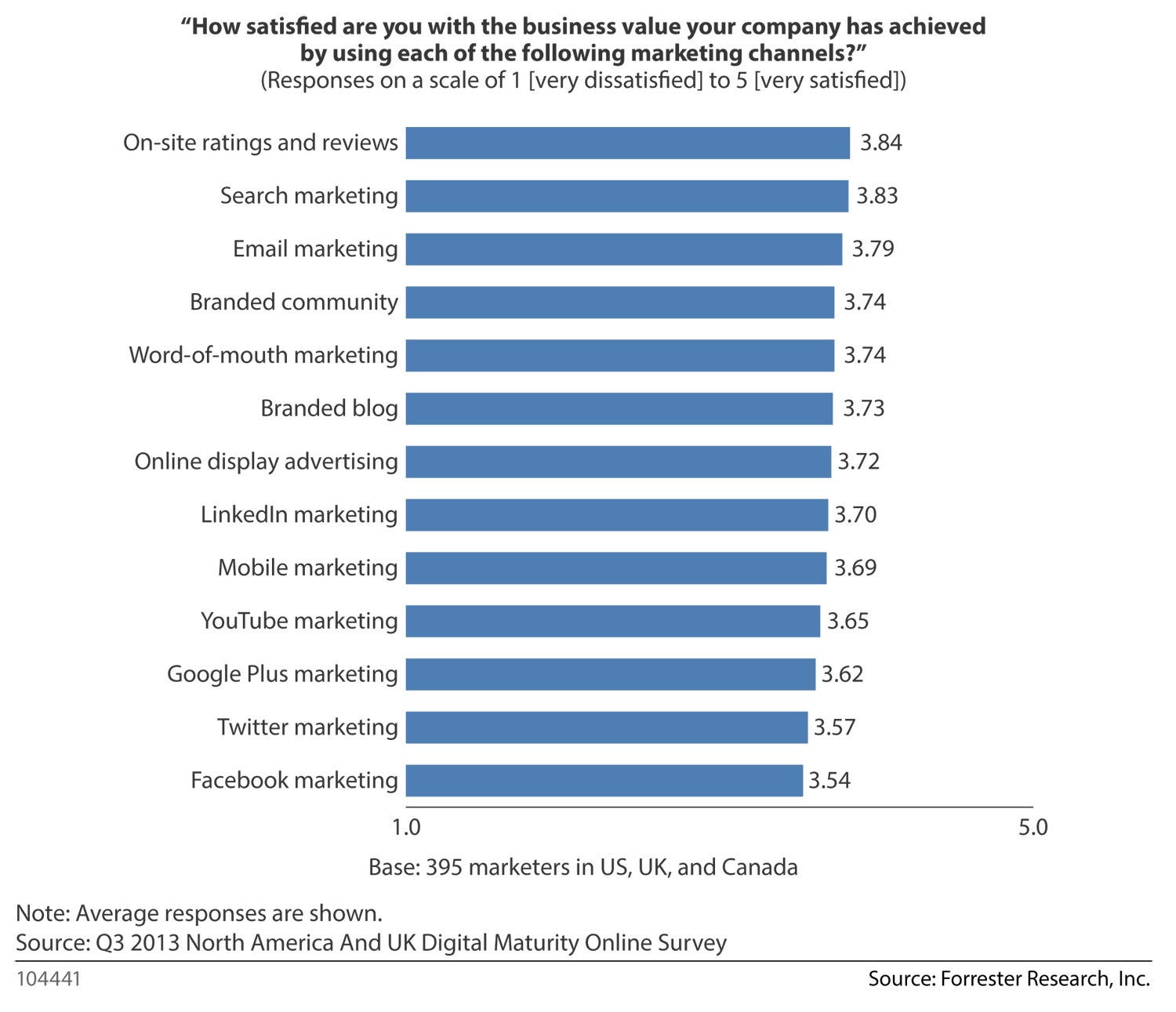
Citing a Forrester survey of 395 marketers and executives at large companies located in the U.S., Canada and the U.K, Forrester was told by the sample that "Facebook creates less business value than any other digital marketing opportunity." Yikes. In fact, according to Forrester, out of 13 different online marketing strategies and sites, Facebook came in dead last, with a satisfaction score of 3.54 on a 5-point scale.

Is Facebook Really a Failure to Marketers?
The reasoning for the apparent disappointment is two-fold. For one, Forrester points out that Facebook isn't good at driving engagement between businesses and their customers.
"Your sales materials tease marketers with the promise that you’ll help them create such connections. But in reality, you rarely do," the report states. Backing up that remark, Forrester claims Facebook, on average, only displays a brand's posts in 16 percent of its fans' newsfeeds. 
Secondly, the site is focusing on traditional, web 1.0 display ads, with less than 15 percent of its ads utilizing social data to reach a more targeted audience.
Sound points, but when you get down to the methodology, I am not how much stock I'd put in Facebook being a disappointment to marketers. 
Keep in mind Forrester only surveyed 395 companies, which might not serve as a big enough pool to provide such a blanket statement that Facebook is failing marketers. Also, Forrester didn't disclose the companies they surveyed, stated the sample was not random and the respondents were rewarded for their information. Plus, Facebook's satisfaction score of 3.54 is 0.3 points away from first place, which could have more to do with a statistical error and less to do with dissatisfaction. 
For its part, Facebook told Business Insider, "the conclusions in this report are at times illogical and at others irresponsible." 
The findings also don't seem to be deterring businesses from jumping on the Facebook bandwagon. According to the report, Facebook brought in $4 billion in advertising revenue last year and 79 percent of businesses market on Facebook.
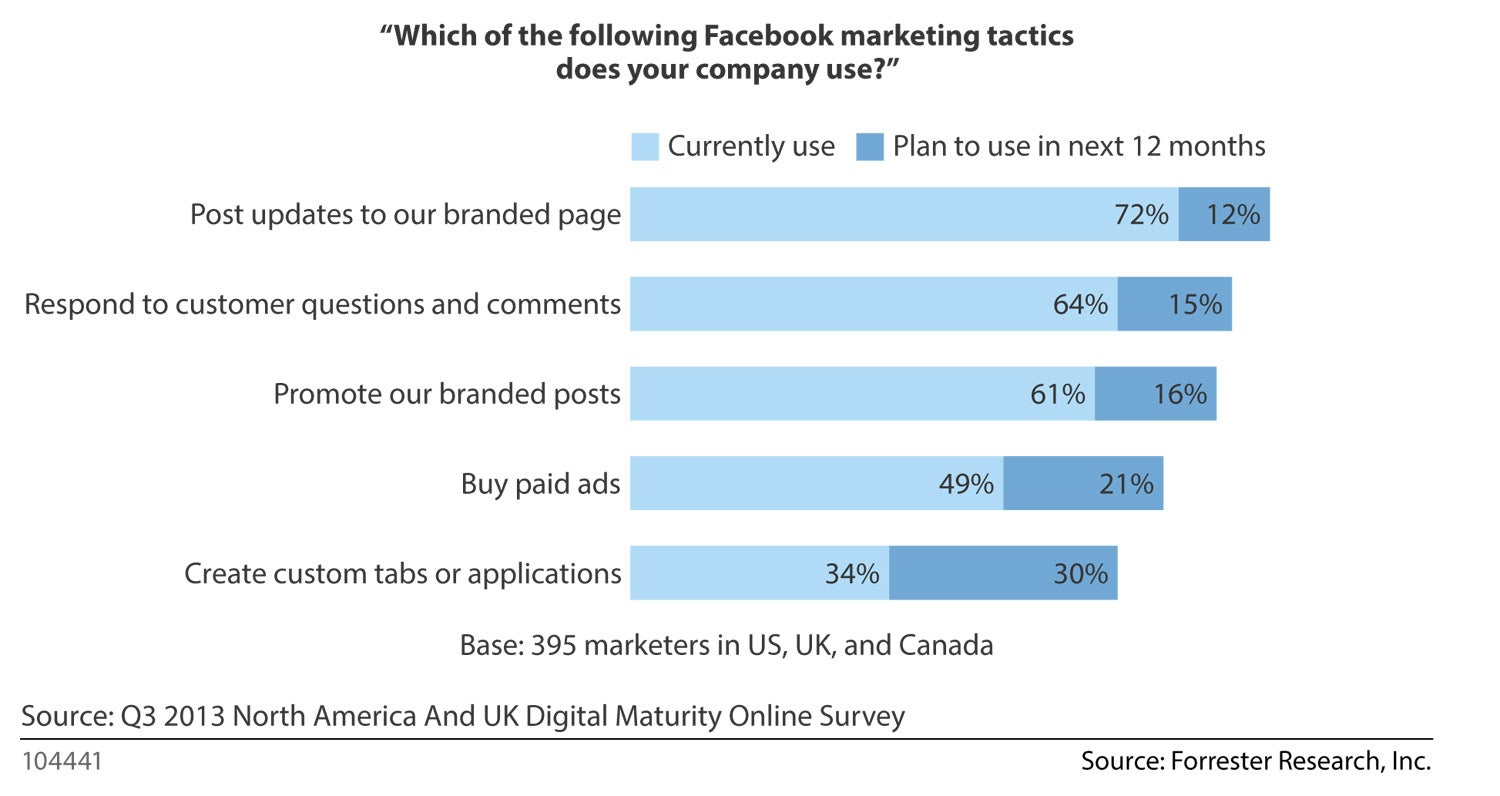
Also, many of those 395 companies surveyed for the report do, or plan on using various Facebook marketing strategies.
Is Facebook Really a Failure to Marketers?
To add to that, Adobe released its first annual Social Media Intelligence report and ad clicks, impressions and marketer's return on investment all increased from 2012 to 2013. The social network's ads were clicked on 29 percent more in 2013, return on investment jumped by 58 percent from last year and click-through-rate was up a whopping 275 percent. 
Also, Google, a company some may state is an arch enemy of Facebook, deciding to partner with the social network and sell its ads on Google DoubleClick Bid Manager. 
But Forrester cautions that Facebook better get its act together or the future may not be so rosy. 
"We don’t believe that Facebook will make the changes needed to win back marketers’ hearts. In fact, we don’t believe the company even sees the need to change: Its enormous revenues have blinded it to marketers’ growing dissatisfaction. But if it doesn’t change, the results will be dire."

Sunday, 24 November 2013

Is Snapchat's Co-Founder Completely Crazy for Turning Down $3 Billion From Facebook?

The internet has been a-buz since news broke yesterday that 23-year-old Evan Spiegel, the co-founder and chief executive of messaging service Snapchat, turned down a $3 billion offer to be acquired by Facebook.
Three billion dollars ain't chump change. Especially for an app that so far isn't generating revenue.
So is Spiegel crazy or crazy smart for not taking all that money? Let us know what you think by taking the poll below.

Saturday, 23 November 2013

What Kind of Entrepreneur Are You?

What Kind of Entrepreneur Are You?The other day I read an interesting book called Entrepreneurial DNA, by Joe Abraham, the founder of BOSI Global, an operating partner to venture-backed and owner-operated companies. The book is based on Joe’s study of over 1,000 entrepreneurs. The research confirmed the discovery that all entrepreneurs are not all wired the same way. The book suggests entrepreneurs fall into four distinct types of entrepreneurial DNA’s that leverage unique strengths, weaknesses and tendencies typical in each specific type of entrepreneur:
1. The Builder: You have a drive to build highly scalable businesses very fast. When this DNA is high in an individual, they break past $5 million in revenue within two to four years and keep going to up to $100 million. That's because these individuals measure success through a very unique lens: infrastructure. It drives the decisions they make and the strategy they build and deploy. They aren't satisfied with a certain amount of personal income or goodwill toward man. They are Pied Piper-like individuals who are master recruiters of talent, investors and customers. Builder DNA activates certain behaviors like a controlling temperament, leading to a Dr. Jekyll and Mr. Hyde like demeanor in the office. Individuals with high Builder DNA tend to struggle most with personal relationships and typically have a revolving door of talent in their companies.
2. The Opportunist: Picture Sir Richard Branson and you have a pretty good idea of what Opportunist DNA is all about. Individuals wired with this DNA are highly optimistic master promoters. They enjoy marketing and selling. They are wired to sniff out well-timed money making opportunities, jump in at the right time, ride the wave of growth up and (hopefully) jump out at the peak. Opportunist DNA measures success based on the amount of money they make (or will make) when they aren't working. So they are drawn to business opportunities where leverage can be used to create residual and renewal income. This behavioral preset in entrepreneurs makes them impulsive decision makers, especially when it comes to money-making opportunities. This trait can serve them very well or be the source of their demise.
3. The Specialist: This DNA activates in the experts of our world. No sooner does an individual go through years of schooling, apprenticeship or on-the-job training, does this DNA activate, driving the corresponding behaviors. Specialist DNA drives one to be very analytical, relatively risk-averse and anti-selling. Specialists generate most of their new business from referrals and networking. They measure success based on their personal income. Their businesses tend to grow fairly well in the startup and early growth phase, but as soon as their personal income hits preset targets, their internal thermostat kicks in and they go into customer service mode. Research found that most Specialist-owned businesses plateau in revenues well below $5 million. The ones that get past this level take significantly longer to get there than Builder DNA companies -- often decades.
4. The Innovator: Picture Mark Zuckerberg in the movie The Social Network and you'll see Innovator DNA at work. Like most Innovators, he was doing something he loved, when a business opportunity popped up. The breakthrough discovery typically drives this entrepreneur in the "lab" of their business -- where they want to invent, design and tinker. They would much rather be in the lab of their business than at the cash register or in the business office. They find operating a business draining. They measure success based on the impact their product or service is having on mankind. "It's not about the money," you'll hear them say. "I'd do this for free for the rest of my life if I could." Individuals with high Innovator DNA control most of the great intellectual property of our time. Unfortunately, they hide in dungeons and find it hard to engage in business discussions.
For centuries the approach to entrepreneurship has been -- what worked for one entrepreneur will work for every entrepreneur. But research has proven that entrepreneurs are all different. Some of us are Innovator-Builders. Others are Specialist-Opportunists.
Knowing your DNA and the DNA of those surrounding you is critical to selecting the business, strategy and team best suited for you. Just because it worked for Richard Branson (Opportunist-Builder) or Bill Gates (Specialist-Builder), doesn't mean it will work for you.